

A ROSARY ABOVE THE CLOUDS

Dawn light over an airport possesses a peculiar stillness: corridors washed in honey‑gold, half‑awake travellers moving softly beneath illuminated departure boards, the scent of coffee and warm croissants lingering in the air before the machinery of the day fully awakens.
Some time ago, on a British Airways flight leaving Venice shortly after dawn, the seat beside mine was taken by a young woman whose serene composure seemed curiously set apart from the subdued restlessness around us. She was slight, perhaps in her early twenties, dressed simply in a light trench coat and a cream‑coloured foulard loosely gathered at her neck. A constellation of freckles crossed her pale face beneath auburn hair falling carelessly to her shoulders.
When she settled into her seat, I introduced myself. She returned the greeting with a small, faint smile, and then told me her name – Kelsey – spoken with that soft, lilting cadence so typical of young British women. Conversation unfolded gently, almost tentatively at first, until we discovered a shared admiration for Catherine, Princess of Wales, and for Lucy Worsley, whose gift for animating history had evidently charmed us both. It was a brief exchange, but touched by that curious ease that sometimes arises between strangers suspended in the liminal hush of early‑morning travel.
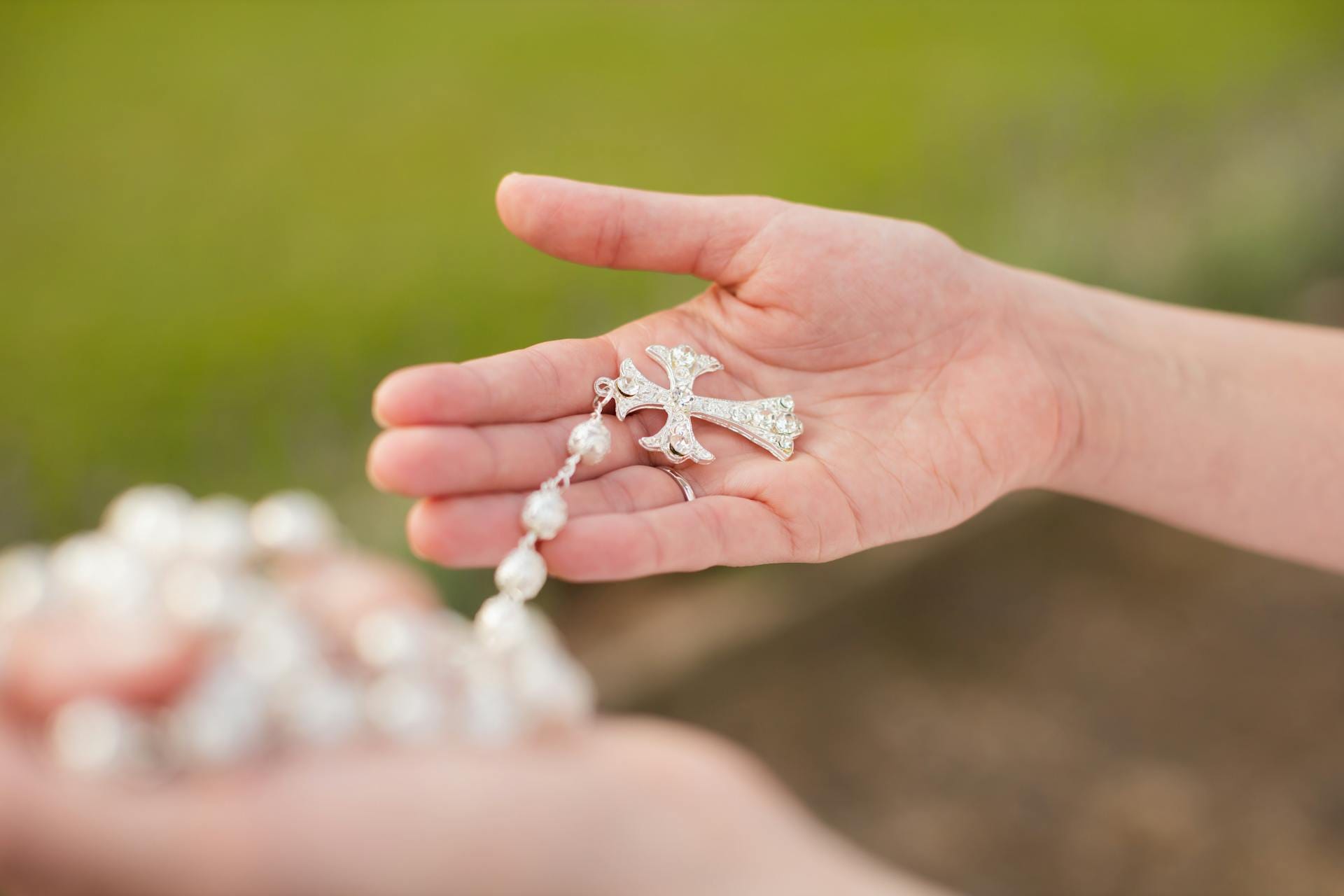
Only then did I notice the rosary resting in her hands.
Not ostentatiously. Not as a display. Simply and naturally, as one might hold an object long woven into the fabric of ordinary life. Her fingers moved lightly from bead to bead while the aircraft rose above the Venetian lagoon into the morning-blue sky. From time to time her gaze drifted toward the window, where the first light spread across cloud and water far below.
After a moment’s hesitation – the kind that precedes any modest act of courage – I turned to her and asked, almost in a whisper, whether she would mind if we recited it together. She looked at me with a mixture of surprise and delight, and nodded. And so we did: in low tones, discreetly, almost beneath the drone of the engines, our voices barely more than breath.
What remains vivid in memory is not merely the rosary itself, but the contrast it created. Air travel has become among the most impersonal of modern experiences – metallic, hurried, anonymous – and yet beside me unfolded a gesture of prayer whose cadence belonged to another world. The muted repetition of the Ave Maria, shared now between two strangers, seemed to draw into that narrow cabin a brief and unexpected stillness.
And so the memory returns now, in this month of May.
For Roman Catholics, May has long been dedicated to the Virgin Mary. The custom emerged gradually within European Christian devotion, shaped both by medieval spirituality and by the ancient association of springtime with beauty, renewal, and maternal tenderness. It is no accident that the language of this season so often turns toward flowers: the Rosary itself, in its very name, evokes a garland of roses offered in prayer. In Catholic culture, Mary is frequently associated with roses, and May – the month of blossoms – becomes naturally entwined with her memory. Thus prayer, flower, and season form a single delicate symbolism.
Throughout the Catholic world, May became a season of Marian hymns, candlelit processions, crowned statues, and the steady recitation of the Rosary.
To many Christians outside Catholic life, the Rosary may appear unfamiliar, or perhaps excessively repetitive. Yet at its heart the devotion is less a departure from the Gospel than a lingering meditation upon it. The ‘mysteries’ of the Rosary contemplate scenes from the life of Christ: the Annunciation, the Nativity, the Crucifixion, the Resurrection. The repetition of prayers forms not so much a mechanical exercise as a rhythm through which the mind gradually becomes calm enough to reflect.
Christianity, after all, has never been afraid of sacred repetition. The Psalms themselves echo and return upon their own words. The Eastern churches repeat the Jesus Prayer in continual succession. Even human affection depends upon repeated phrases whose meaning deepens rather than diminishes through constancy.
That is why the memory of that early‑morning flight has lingered so persistently. In the midst of an age increasingly hostile to contemplation, the sight – and sound – of two people praying together, not performing belief but simply inhabiting for a few moments a deeper order of attention, felt like the recovery of something almost forgotten.
This is what remains most vividly from that departure out of Venice: not merely rosary beads passing through slender fingers, but the rare, unexpected intimacy of shared inwardness.