


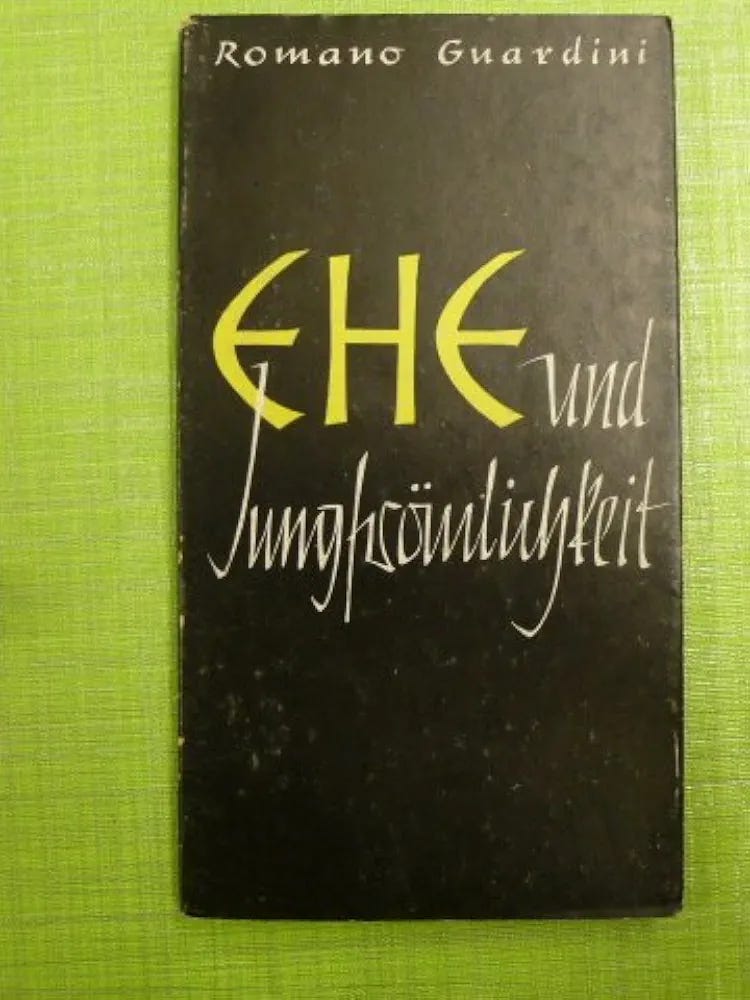
Today, to speak of marriage is already to step into contested territory. The word carries with it a sense of weight, even of risk: a promise that seems increasingly fragile in a culture wary of long horizons. And to speak of virginity – of desire held open, of a life shaped by availability rather than acquisition – can feel almost like invoking a forgotten grammar. Yet precisely in this moment of uncertainty, Romano Guardini’s Ehe und Jungfräulichkeit (‘Marriage and Virginity’) offers a way of thinking that is neither nostalgic nor defensive, but quietly, insistently hopeful.
Guardini’s writing has a distinctive patience. He does not rush to define or to resolve. Instead, he invites the reader to inhabit the questions themselves: what it means to desire without fear, what it means to commit without illusion, what it means to let the shape of one’s life be formed by something more than preference or circumstance. His concern is not primarily with rules or ideals, but with the texture of human freedom – how it feels, how it grows, how it is sustained.
Marriage, in this vision, is not a fortress of certainty but a practice of attention: a slow, sometimes painful, sometimes luminous apprenticeship in learning to see another person truthfully. Virginity, likewise, is not a denial of desire but a way of letting desire breathe in a larger space, a sign that longing can be offered without being extinguished. Both forms of life, Guardini suggests, are gestures of trust: trust that the human body is not an obstacle to grace, and that desire, when listened to carefully, can become a path rather than a threat.
This is why his reflections speak so clearly into the present. We live in a world where singleness is increasingly common, often chosen, and often misunderstood. Guardini does not treat solitary life as a waiting room before something more ‘real’ begins. He sees it as one of the ordinary ways in which a person may inhabit the world faithfully, with a kind of spaciousness that allows for deep attention – to God, to others, to the fragile communities that sustain us.
From here, a wider conversation opens. Guardini writes from a particular tradition, yet his insights resonate across others: covenantal understandings of marriage, sacramental accounts of the body, ecumenical reflections on vocation. What matters is not the doctrinal scaffolding but the posture: a refusal to set vocations against one another, a willingness to let each illuminate the other. Marriage and virginity become, in his hands, two ways of tracing the same gospel shape in human lives.
And so the centenary of this 1926 classic becomes something more than a historical marker. It becomes an invitation to think again – slowly, attentively, with the courage to let desire be spoken of without embarrassment, and commitment without cynicism. Guardini’s book is slender, but the space it opens is wide. It asks how Christians desire, how they commit, how they belong, and how the gospel might still shape the most intimate dimensions of human life.