

When Bones Speak
What the unveiled remains of Francis of Assisi say to us

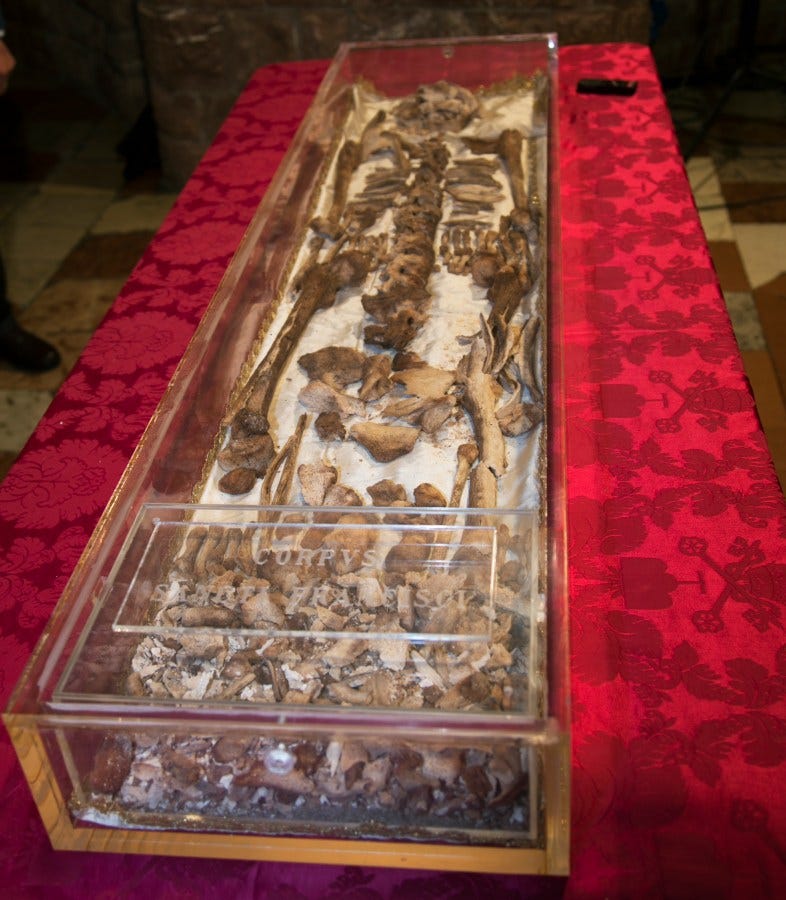
Here they are: the bones of Francis of Assisi, visible for a time beneath a clear slab in the lower church – unveiled now, eight centuries after his death. Simply present, offered to human gaze. For Catholics these are relics to be venerated; many other Christians, by contrast, view such a practice with a certain scepticism. Yet whatever one’s instinctive response, the question arises almost at once: what does such a sight say?
These fragments of a life interrupt us. They cut through the stories we use to soften the truth of our condition. They remind us that we inhabit a structure we did not choose and will one day relinquish. And perhaps that is why their presence can feel like a summons. Not to fear, but to honesty.
We often imagine theology as something that belongs to the realm of pure abstraction, untouched by the gravity of flesh. Yet our thinking, too, is embodied. Long before any concept forms, our living teaches dependence, exposes vulnerability, awakens joy. Meaning presses itself upon us through the very texture of our existence, well before we attempt to name it – in those pre‑reflective certainties that, as Antonio Livi observed, every child acquires long before philosophy or science: the fact of being here and of the world’s continual becoming, the awareness of self, the presence of others, the intuition of right and wrong, the sense of a grounding reality.
To stand before human remains is to be reminded that our lives are not self‑authored. We inhabit a form that precedes us and will outlast us. And yet Christian faith refuses to treat this as humiliation. The Incarnation contradicts our instincts: God does not sidestep our condition but embraces it, taking on its weight, its limits, its capacity for pain and delight. The Eternal does not hover above the human; he enters the most elemental layers of our being.
Scripture is strikingly unembarrassed about what endures after death. Ezekiel’s valley is not a meditation on decay but on recognition: the Holy One calling what has fallen apart back into coherence. The scattered pieces come together not because they possess some hidden vitality but because they are remembered. They are known. They are held in a fidelity that does not loosen its grip even when life has ebbed away. This is the grammar of resurrection: not the triumph of spirit over matter, but the vindication of matter by the Creator who refuses to discard what he has shaped.
We live in a culture that treats the human frame as a project – optimised, curated, endlessly improved. Fragility becomes an inconvenience; ageing a kind of failure. But the starkness of bone resists this fantasy. It tells us that we are not self‑inventing creatures. We are dust: dust breathed into, dust beloved, dust destined for more than its own dissolution. To acknowledge this is not resignation. It is reverence. Our limits are not obstacles to grace; they are the very places where it becomes visible. Our creatureliness is not a problem to be solved but a mystery to be inhabited.
So what does one learn, standing before the remains of Francis? Perhaps that the following of Christ is not a matter of escaping the human condition but consenting to it. Perhaps that our frailty, in all its wear and weathering, is not an impediment to the divine work but its chosen medium. Perhaps that death, which we fear as erasure, is held within a larger fidelity than our imaginations can bear.
A theology of bones is, in the end, a theology of trust. It tells us that the One who formed us does not abandon what he has made. It tells us that the final word spoken over human life is not silence but recognition – the One who called us into being calling us once more into life.